
Pre-designed tanks and modules.
Two system types, parametric hybrid and RAS, in two delivery formats: independent production units and production modules. Tank range Ø10 to 30 m. Engineered once, delivered many times.
Two system types, two delivery formats.
Pick the delivery format that fits your site and the system type that fits your water. Every combination is pre-designed, from Ø10 to 30 m.
Independent production unit (IPU)
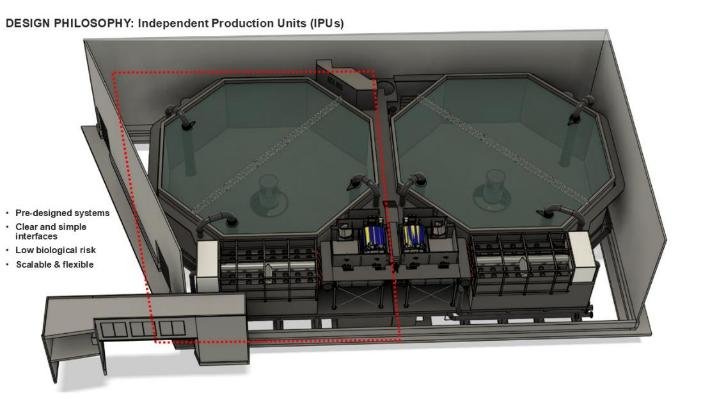
One tank, its own water treatment.
Production module
Several tanks, one treatment system. Flexible grouping and layouts.
Parametric hybrid
No biofilter · seawater and freshwater
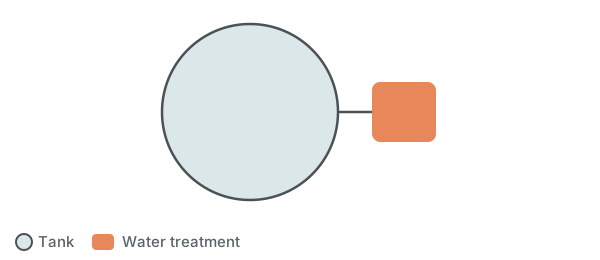 Parametric hybrid · IPU
Hybrid IPU
Drum filter, degassing and oxygenation in an active loop beside the tank. Low water exchange, with feedwater adjustable on a sliding scale.
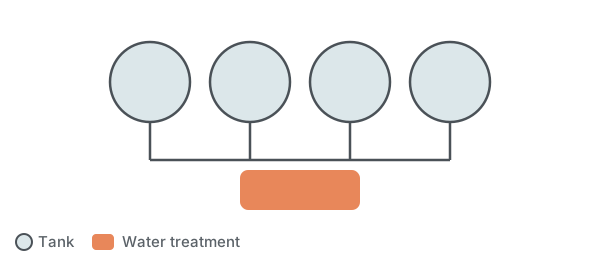 Parametric hybrid · Production module
Hybrid module
The same treatment loop shared by a group of tanks. Water is exchanged only within the module.
RAS
Biofilter in the tank · freshwater
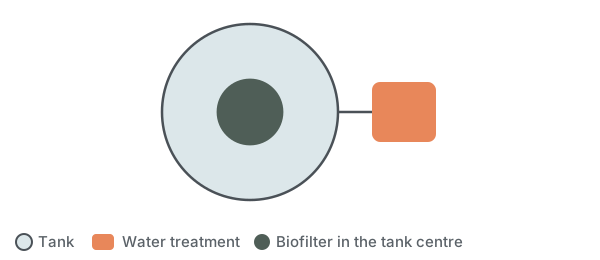 RAS · IPU
RAS IPU
Biofilter in the centre of the tank, with its own treatment unit. Switch to hybrid mode in seconds to isolate the biofilter from the fish.
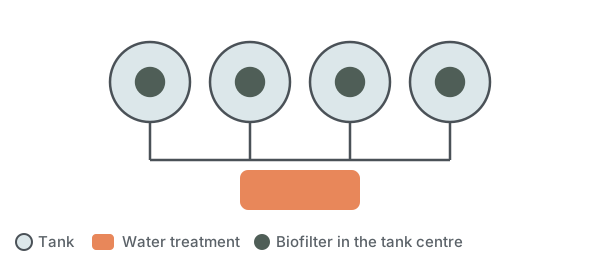 RAS · Production module
RAS module
A group of RAS tanks with individual biofilters, served by shared infrastructure.
Stop choosing once for the whole facility.
Land-based farmers usually choose between recirculation — control at an energy cost — and flow-through — simplicity with more exposure to the intake water. Ontec’s parametric hybrid gives an active treatment loop with far less water in and out than a conventional hybrid. In a RAS system, each tank can switch to hybrid mode or flow-through as the fish, the water and the season require.
Two system types, one principle.
Parametric hybrid has no biofilter: an active loop filters, degasses and oxygenates the water, so far less water goes in and out than in a conventional hybrid, and the feedwater can be set on a sliding scale. RAS adds a biofilter in the centre of the tank, for freshwater, and can switch to hybrid mode or flow-through when needed.
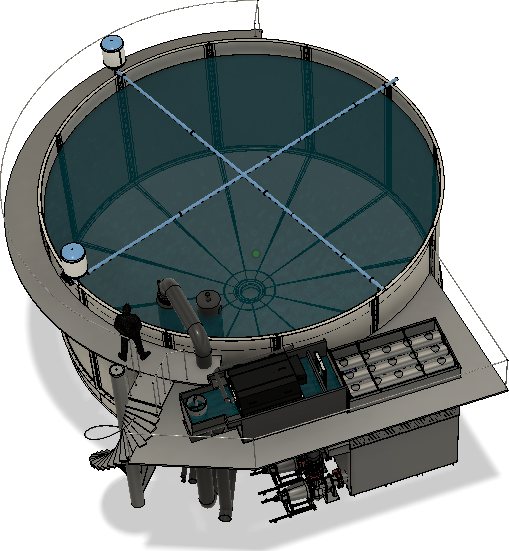
Isolate the biofilter in seconds.
Switch a RAS tank to hybrid mode and its biofilter is cut off from the fish in seconds. That is a new layer of biosecurity.
- Operators rebalance water chemistry in the tank and in the biofilter, for example by raising nitrate (NO₃) levels, before restoring RAS mode.
- The hydrogen sulphide (H₂S) risk of a biofilter stays confined to a single tank.
- Fish can be purged before harvest in the same tank.
Together, this significantly reduces the risk of mass mortality.
What leaving out the biofilter changes.
Results from two production cycles and the modelling done at Ontec Academy.
Less new water
Compared with conventional hybrid flow-through.
More volume per tank
Farming volume gained when the central biofilter of a RAS tank is left out.
CO₂ at 126 kg/m³
Stable water quality, with CO₂ below 11 mg/l through the cycle and ammonia well within limits.
Time to respond
Instead of minutes. Most night-time alarms can wait until the morning shift.
No acid or base dosing, and no biofilter to mature or protect. Modelled energy for temperature control is about 0.4 kWh per kg of fish at 10 °C with local seawater temperatures.
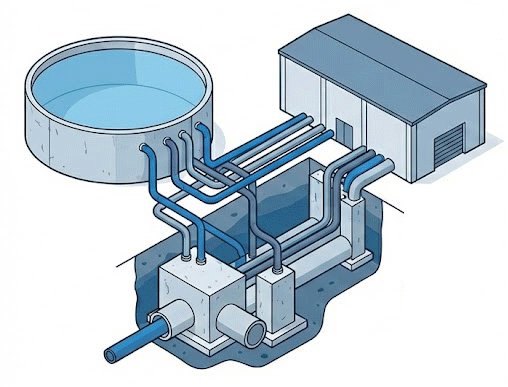
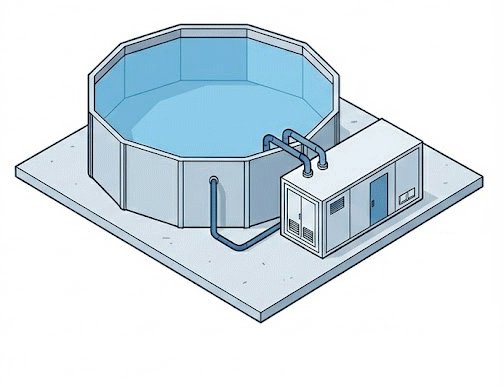
Clean water in, treated at the tank.
Water is drawn from the intake, pre-treated, and handled at each tank or tank group by its own compact unit.
Water use set per mode.
Parametric hybrid runs an active treatment loop with low water exchange, adjustable on a sliding scale. RAS exchanges under 1% of volume per hour. Fewer pumps and short water transport keep energy use down.
Simpler groundwork, staged growth.
Piping is pre-designed into each tank’s fundament, so little more than floor drains goes under the floor. That means simpler groundwork, concrete and piping. Facilities grow in stages, without major construction noise. Ontec puts the cost at 60–70% of the industry average capex per kg.
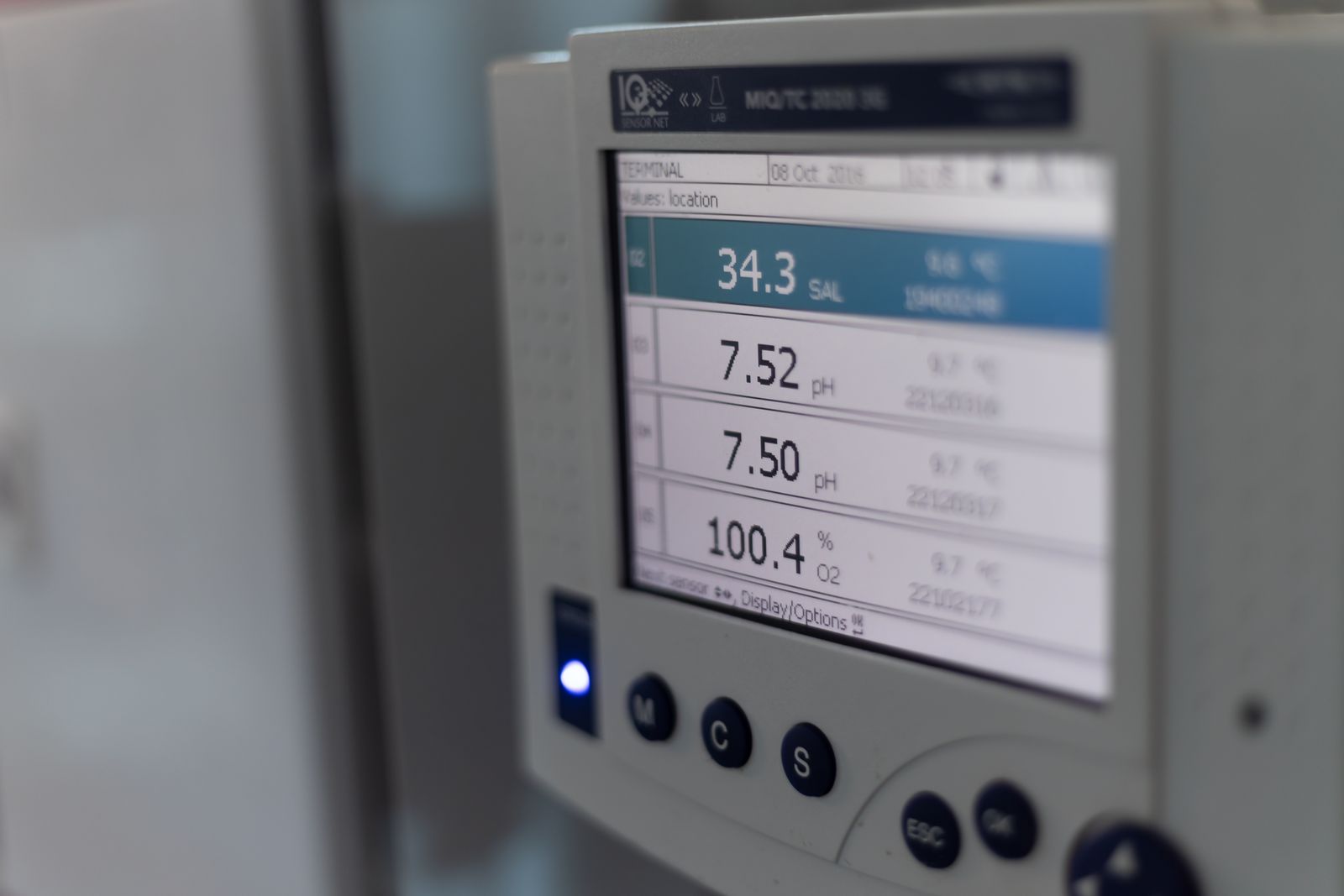
Run by parameters, not guesswork.
The control calculates what each tank should measure. Continuous sensors, which drift over time, and precise spot measurements of pH and ammonia are checked against that prediction, and any deviation carries information. Operators see every tank in one view. The control system was developed with Sætren and Piscada, with a live dashboard for biological and technical performance.
Measurement and control sit next to each other, with short water transport.
Water chemistry, gas control and temperature are steered tank by tank.
pH changes not explained by predicted respiration can point to disease or stress. Feed control shows over- and underfeeding, or that something affects digestion or feed quality.
Automatic control, decision support and early warnings: biological and technical expertise built into the system.
Pre-designed from Ø10 to 30 m.
Fibreglass tanks for the smaller sizes, concrete for the larger. Water depth grows with diameter, which sets the volume. Any size between Ø10 and 30 m can be pre-designed; these six are the standard range.
| Tank | Material | Water depth | Volume (m³) |
|---|---|---|---|
| Ø10 m | Fibreglass | 4 m | ≈ 310 |
| Ø12 m | Fibreglass | 4 m | ≈ 450 |
| Ø15 m | Fibreglass | 5 m | ≈ 880 |
| Ø20 m | Concrete | 6 m | ≈ 2,000 |
| Ø22 m | Concrete | 7 m | ≈ 2,800 · first commercial stage in Måløy |
| Ø30 m | Concrete | 8 m | ≈ 6,000 |
Approximate volumes for parametric hybrid tanks. In a RAS tank, the central biofilter takes up about a fifth of the volume.
Request a spec sheetWhere Ontec differs.
Ontec’s two system types next to conventional RAS and flow-through, in plain terms.
| Aspect | Ontec · Parametric hybrid | Ontec · RAS | Conventional RAS | Flow-through |
|---|---|---|---|---|
| Water | Seawater and freshwater | Freshwater | Freshwater or seawater | Seawater or freshwater |
| Biofilter | None | In each tank; isolated in seconds by switching to hybrid mode | Central, shared by all tanks | None |
| Water exchange | Low; feedwater adjustable on a sliding scale | Under 1% of volume per hour | Under 1% of volume per hour | ≈80% of volume per hour |
| New water, m³ per kg feed | 4–8 | 0.5–2 | 0.5–2; 0.05–0.2 with denitrification | 40–60 |
| Shared water | None between IPUs; within the module only | None between IPUs; within the module only | All tanks share loops through a central plant | Directly exposed to intake water |
| H₂S risk | No biofilter, no biofilter-related H₂S | Confined to one tank | Can affect the whole facility | — |
| Under the floor | Floor drains; piping in the tank fundament | Floor drains; piping in the tank fundament | Large consolidated pipes in the ground | Large intake and outlet works |
| Off-flavour purging | In the same tank | In the same tank, in flow-through mode | Separate purge step or tanks | Limited control |
| Design approach | Pre-designed, plug-and-play units | Pre-designed, plug-and-play units | Central plant designed for each site | Intake and outlet works designed for each site |
Can one facility run different modes at the same time?
Do I need a biofilter?
How do you handle off-flavour?
Can RAS with a biofilter run on seawater?
Can Ontec units go into an existing facility?
What water supply does a site need?
Can we build in stages?
What does operator training include?
How long does a project take?
Spec sheets for the Ø10–30 m range.
Tell us the tank size, the product type and your site, and we’ll send the spec sheet with a first sizing.
Planning an upgrade or a new facility? Let’s look at your site.
Talk to the engineers, or come and see the system in Måløy.